
Cobalt Giraffe Thinking
Agentic AI and the Operating Model
Agentic AI isn't just a technology change. It introduces a different kind of worker into the organisation.
A Thinking proposition, not a validated industry framework.
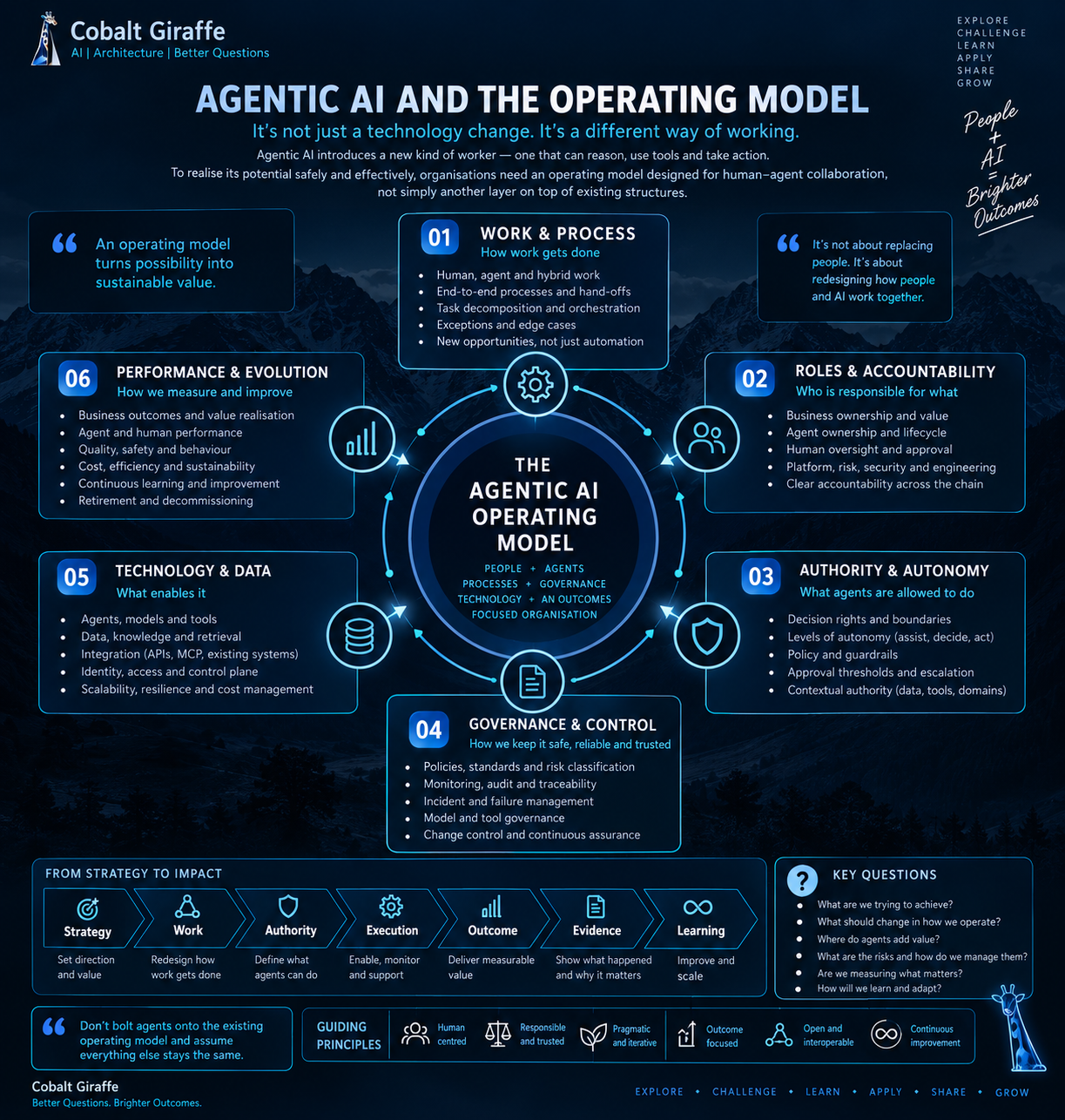
Agentic AI and the operating model
For much of the recent AI wave, the organisational question has been relatively familiar:
How do we give people better tools?
Agentic AI changes that question.
Once software can interpret a goal, decide what to do next, use tools, interact with enterprise systems, delegate work and potentially take consequential actions, it starts participating in the work itself.
That doesn't make an agent an employee.
But it does mean that simply adding agents to existing processes and wrapping them in technical controls is unlikely to be enough.
The operating model has to evolve too.
Who does the work?
The first question isn't where to deploy an agent. It is how the work should operate.
Some activities remain human. Some may become agent-led. Many will become hybrid.
That changes process design, hand-offs, exception handling and potentially the boundaries between functions.
The interesting opportunity may not be automating today's process at all. Agentic capability may allow the work to be redesigned.
Who is accountable?
Agents can perform work, but accountability cannot simply disappear into the technology.
Organisations need clarity about business ownership, agent ownership, human oversight, platform responsibility, risk, security and engineering.
Someone still needs to own the outcome.
What authority does an agent have?
Identity answers one question: what is this agent?
Authority answers another: what is it permitted to do, on whose behalf, under what conditions and within what limits?
Different work requires different levels of autonomy.
An agent suggesting an action is not the same as one making a decision. Making a decision is not the same as executing a consequential transaction.
Those boundaries need to be designed deliberately.
How is it governed?
Governance for agentic systems cannot only be a design-time exercise.
Agents operate in changing environments, with changing data, permissions, policies and tools.
That makes monitoring, evidence, traceability, incident management, evaluation and lifecycle control part of the operating model.
Controls also need to exist where actions occur, not simply where an agent was originally instructed.
What enables it?
The technology still matters.
Agents need models, tools, knowledge, APIs, identity, data, observability and appropriate control mechanisms.
But the technology architecture should implement the operating model rather than accidentally define it.
The organisation should decide how work, authority and accountability operate first.
Architecture can then make those decisions executable.
How do we know it is working?
Traditional technology measures are not enough.
An agentic operating model needs to connect technical performance to business outcomes, quality, safety, behaviour, cost and the performance of the wider human-agent system.
And it needs to learn.
Agents will change. Models will change. Processes will change. Organisational confidence in autonomy may change too.
So the operating model cannot be static.
The bigger shift
The interesting question about agentic AI may therefore be less:
“Where can we deploy agents?”
and more:
“What should work look like when people and increasingly capable software can both reason and act?”
That leads from technology into process, organisation, authority, governance and accountability.
Agentic AI isn't simply another layer to bolt onto the existing operating model.
It is a reason to examine the operating model itself.