
Authority and confidence
Source authority concerns who or what the source represents. Claim confidence concerns how strongly the available evidence supports a particular statement. One does not substitute for the other.
Architecture knowledge / evidence-led investigation
Architecture Intelligence Atlas
Beyond storing the architecture.
Understanding the basis for it.
Architecture repositories are good at storing diagrams and documents. They are less good at keeping four questions in view:
Active research / demonstrator
Enterprise architecture information is spread across diagrams, presentations, decisions, standards, spreadsheets, project documents, repositories and individual knowledge.
The difficulty is not simply storing those artefacts. It is preserving the relationships between them, and understanding the strength of the evidence behind an architectural statement.
Atlas explores whether that knowledge becomes more useful when capabilities, patterns, technologies, controls, decisions, claims and evidence are treated as related objects rather than isolated documents.
Can an architecture repository become more useful if it records not only architecture objects, but also the explicit relationships, evidence, provenance and uncertainty behind them?
The investigation focuses on making an architectural position inspectable: what it refers to, what supports it, what challenges it and what still needs to be established.
The central reading path is simple: Problem → Capability → Pattern → Technology / Implementation → Control → Evidence. Start with a need, identify the ability required, explore a reusable approach, examine its possible realisation and controls, then ask what evidence supports the position.
Decisions and claims capture the position being taken. Concepts and principles help explain its meaning. Questions, assessments and gaps record what needs scrutiny. The wider model considers these distinctions; the public Build exposes a deliberately smaller selection.
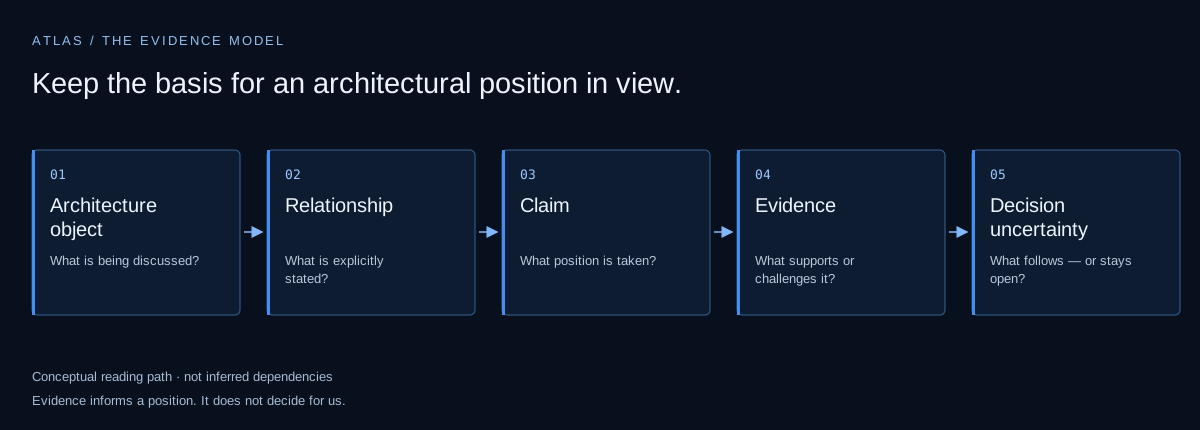
A normal hyperlink is navigation. An Atlas relationship is an explicitly authored architectural statement. Its type matters.
The demonstrator follows these authored links. A line on the graph is not proof that the corresponding dependency exists in a deployed system.
A source can be authoritative about what was approved without proving what was implemented. A claim can sound convincing while its supporting evidence remains narrow. Atlas keeps those distinctions visible.
Source authority concerns who or what the source represents. Claim confidence concerns how strongly the available evidence supports a particular statement. One does not substitute for the other.
A documentary statement is different from implemented behaviour. An approved decision records a position; it does not establish a successful deployment.
Supporting evidence bears on whether a claim holds. Provenance records where information came from and how it was derived. Repeating one source does not create independent corroboration.
Missing evidence leaves a question open. It does not prove a claim false, or a dependency absent.
These states describe the position within a stated scope, not a permanent verdict. The public selection illustrates some of them; it is not a complete inventory of the wider model.
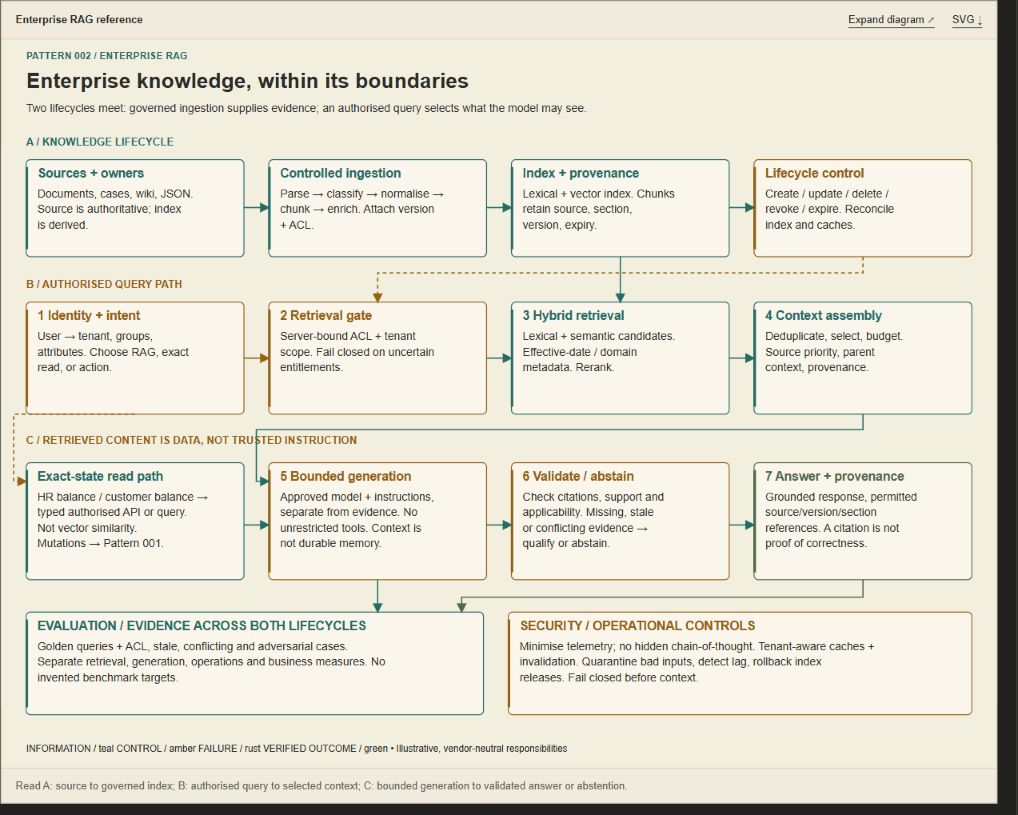
A pattern describes responsibilities, boundaries, decisions, controls, failure modes, evidence and observability considerations, and possible technology realisations. It helps structure a design discussion; it is not a certificate of suitability.
The published Build contains three existing references: Consequential Agent Action, Enterprise RAG and Agentic Workflow. Their diagrams and detailed views retain their own illustrative scenarios, separate from the fictional Asteron evidence.
The broader research scope also includes Event-Driven Autonomous Operations, Secure AI / Sensitive Data and Model Context Protocol. Those topics are not part of the three-pattern public selection shown here. Availability must not be mistaken for production proof.
Explore the published pattern selectionThe work tested how a small, curated architecture could remain navigable without losing the basis for its statements.
Automated checks verify the selected model’s identities, relationship endpoints, scoped traversal and search. Browser checks exercise navigation, evidence selection and responsive presentation. These checks establish behaviour in this demonstrator, not the completeness of an enterprise inventory or an improvement in real-world decision quality.
The bounded work supports a set of design lessons. Broader usefulness still needs evaluation in real architecture work.
The current public Build is a read-only fictional demonstrator: 33 architecture objects, 50 authored relationships and three selected pattern references. Its organisations, decisions and evidence are invented.
Recorded dependency traversal is a bounded review aid. The demonstrator does not ingest a live estate, infer missing links or validate a real deployment. No private corpus, client architecture or personal learning records are published.
11 / From lab to Build
Labs records the question and the learning. The Build lets visitors explore those ideas in a fictional architecture.
Follow explicit relationships, inspect patterns and evidence, review a disputed claim, revisit a superseded decision and trace recorded dependencies. These are views over authored material, not generated recommendations.
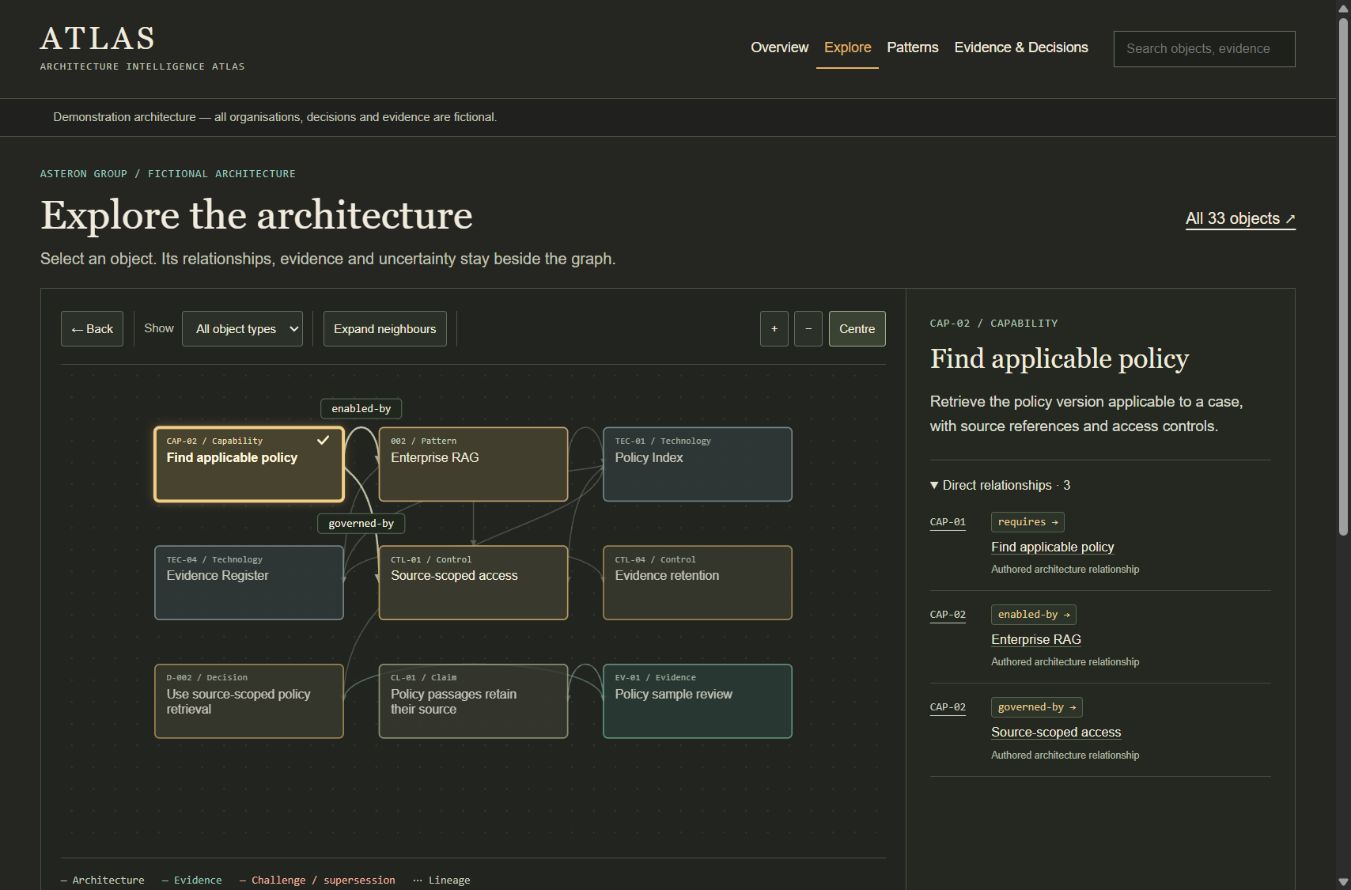
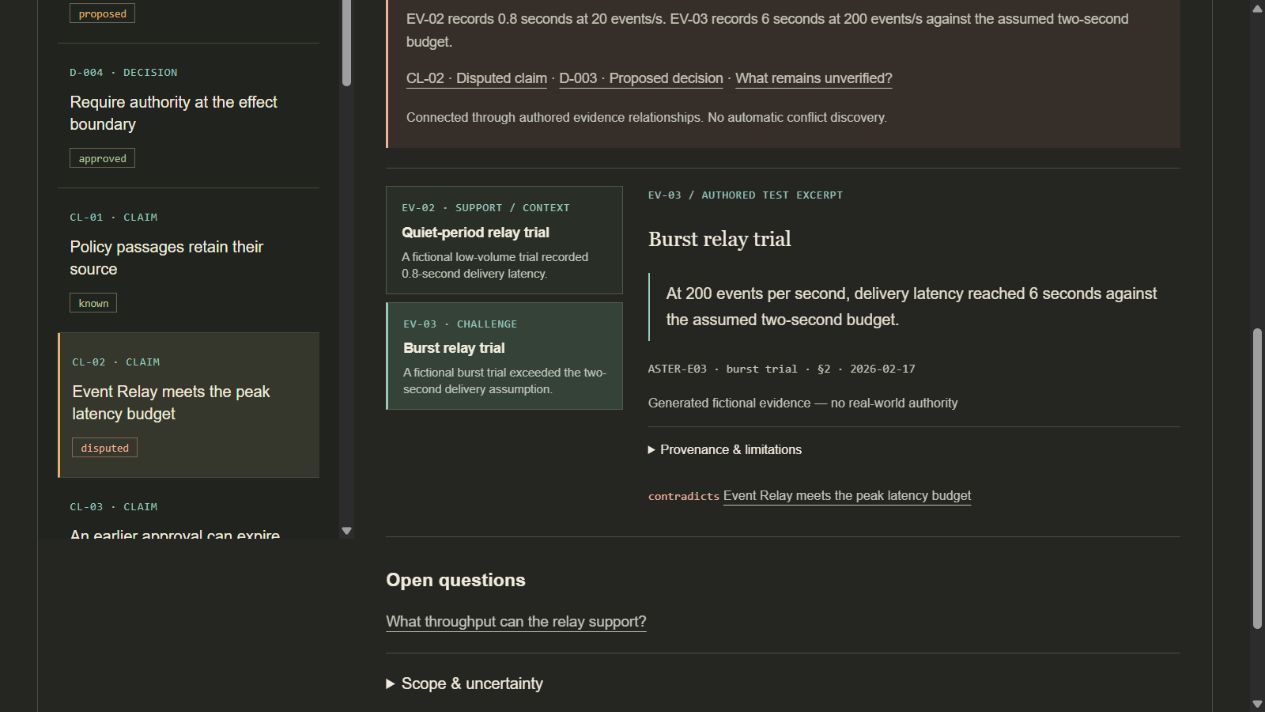
The next question is whether this structure helps people recover context, challenge a position and identify missing evidence in representative architecture tasks. That would need independent review against a known set of sources, with mistakes and missing coverage recorded.
The demonstrator is a way to inspect the design before claiming that wider benefit.
Back to the Labs collection